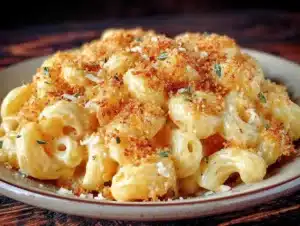
The neighborhood potluck was in six hours and I’d completely forgotten. I mean, completely. I was standing in my kitchen at 2 PM on a Saturday, staring at my pantry like it had personally betrayed me. Everyone else would be bringing those elaborately layered dips, the homemade bread that takes three days to proof, the desserts that look like they belong in a bakery window. And me? I had a butternut squash that was starting to look a little sad, half a block of cheddar, and a box of pasta I’d bought on a whim. Honestly, I almost just grabbed a bottle of wine and called it a contribution.
But here’s the thing about desperation cooking — it sometimes makes you a genius without meaning to. I remembered a friend mentioning something about blending squash into cheese sauce once, and my brain latched onto it like a lifeline. I figured, worst case scenario, I’d have a weird orange mess that nobody touched. Best case? Well, I was about to find out. I chopped that squash, boiled it until it was tender, and threw it in the blender with the cheese and milk. It looked promising. It smelled even better. I poured it over the pasta, threw some breadcrumbs on top, and shoved it in the oven with exactly zero confidence.
At the potluck, I watched people go back for seconds. And thirds. Someone asked for the recipe before they even finished their first serving. My little last-minute disaster was the first dish to run out. I stood there holding an empty baking dish, feeling sheepish and secretly smug. That’s the night this butternut squash mac and cheese became my go-to for every gathering. It’s the dish I bring when I want to look like I planned something brilliant, when really I just got lucky with a squash and a deadline. Maybe you’ve been there — that moment when the clock is ticking and you need something that delivers. Trust me, this one delivers.
Why You’ll Love This Recipe
Let me tell you why this isn’t just another mac and cheese recipe. I’ve tested this about seven times since that first panicked potluck, tweaking the ratios and the roasting time until it was just right. Here’s what makes it stand out:
- Quick & Easy: Comes together in about 45 minutes, most of which is hands-off oven time. Perfect for those days when you need something impressive without the stress.
- Simple Ingredients: No fancy cheese shops or specialty stores. You probably have most of this in your kitchen right now. The squash does the heavy lifting.
- Perfect for Hosting: This dish is designed for gatherings. It scales beautifully, holds well in a warm oven, and looks gorgeous on a buffet table. Your guests will think you spent hours on it.
- Crowd-Pleaser: I’ve served this to kids who “don’t eat vegetables” and adults who consider themselves food snobs. Everyone loves it. The squash adds creaminess without screaming “healthy.”
- Unbelievably Delicious: The texture is next-level. Velvety, rich, with that perfect golden crust on top. It’s comfort food that feels a little fancy.
What makes this different from every other mac and cheese recipe out there? It’s the roasted squash. Instead of just adding puree for color, I roast the squash first to concentrate its natural sweetness. That caramelized flavor blends into the cheese sauce in a way that makes you wonder why you ever made it any other way. It’s not a healthified version of mac and cheese — it’s a better version, period.
This is the kind of recipe that makes you close your eyes after the first bite. It’s comfort food reimagined — richer, more satisfying, and somehow still simple. Perfect for impressing guests without breaking a sweat, or turning a regular Tuesday into something special.
What Ingredients You Will Need
This recipe uses simple, wholesome ingredients to deliver that velvety, crowd-pleasing result. Most are pantry staples, but the squash is the real star here. Let me walk you through what you’ll need.
For the Roasted Squash
- 1 medium butternut squash (about 2 pounds or 900g) — peeled, seeded, and cubed into 1-inch pieces. Look for one that feels heavy for its size with firm, unblemished skin.
- 2 tablespoons olive oil — for roasting. A good quality extra virgin works fine here.
- 1/2 teaspoon salt — to draw out the squash’s natural sweetness.
- 1/4 teaspoon black pepper — freshly ground if you can.
For the Pasta and Cheese Sauce
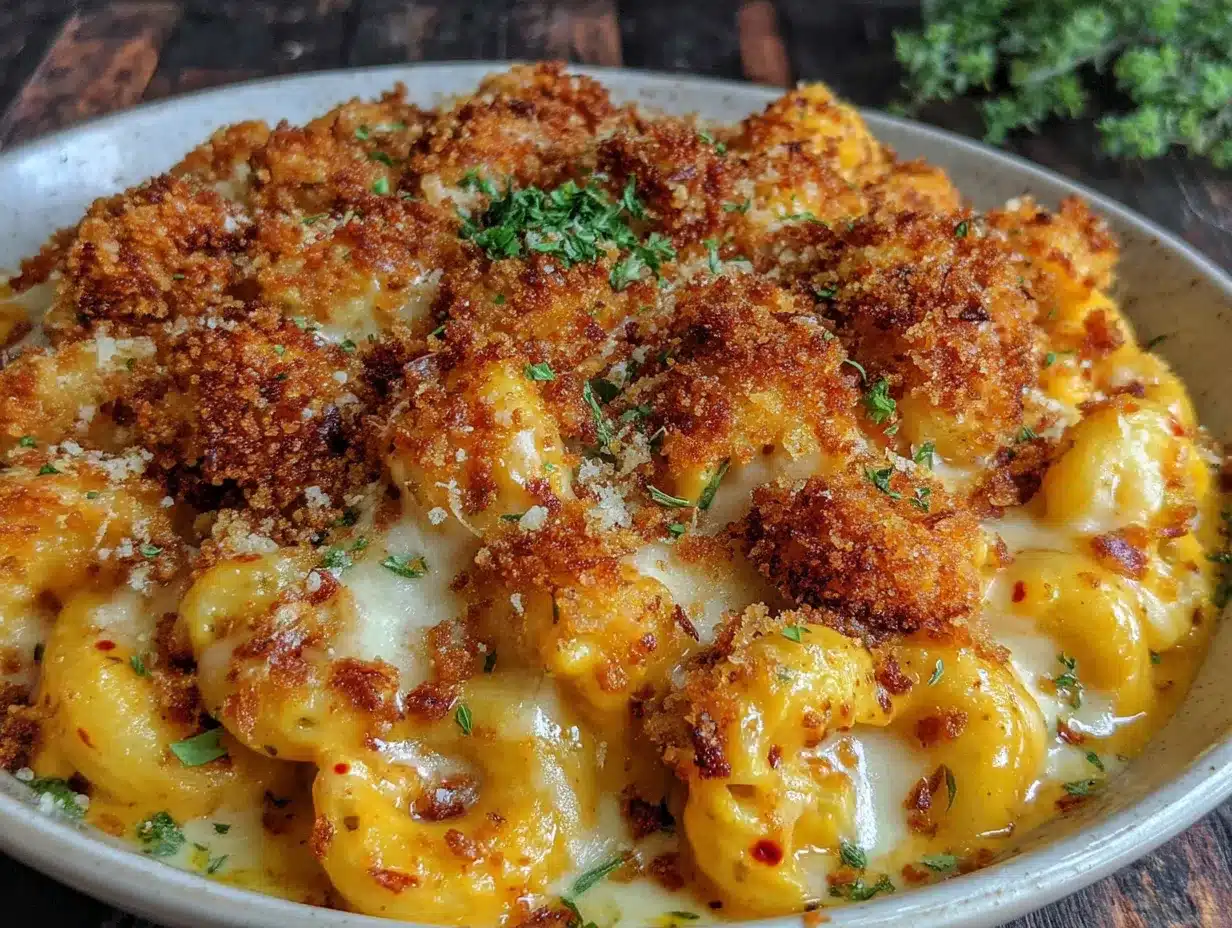
- 1 pound (450g) elbow macaroni — or any short pasta like cavatappi, shells, or fusilli. I prefer cavatappi because the ridges hold the sauce beautifully.
- 4 tablespoons (56g) unsalted butter — for the roux. You can use salted butter, just reduce the added salt slightly.
- 1/4 cup (30g) all-purpose flour — this thickens the sauce. For a gluten-free version, use a 1:1 gluten-free flour blend.
- 3 cups (720ml) whole milk — warmed slightly. Whole milk gives the creamiest result, but 2% works too. Avoid skim milk — the sauce won’t be as luxurious.
- 1 cup (240ml) heavy cream — for that extra richness. You can substitute with half-and-half if you prefer.
- 2 cups (225g) sharp cheddar cheese — freshly grated. Please don’t use pre-shredded cheese; it has anti-caking agents that prevent smooth melting. I recommend a good aged cheddar for maximum flavor.
- 1 cup (115g) Gruyère cheese — freshly grated. This adds a nutty, creamy depth that cheddar alone can’t match. If Gruyère is hard to find, use more cheddar or add some Monterey Jack.
- 1/2 cup (50g) Parmesan cheese — freshly grated. For the sauce and the topping.
- 1 teaspoon Dijon mustard — don’t skip this. It doesn’t make the sauce taste mustardy; it just sharpens the cheese flavor.
- 1/2 teaspoon garlic powder — optional, but I love the subtle warmth it adds.
- 1/4 teaspoon nutmeg — freshly grated if possible. It’s a classic pairing with butternut squash.
- Salt and pepper — to taste.
For the Topping
- 1 cup (100g) panko breadcrumbs — they give the best crunchy texture. Regular breadcrumbs work, but panko stays crispier.
- 2 tablespoons (28g) unsalted butter — melted, to toss with the breadcrumbs.
- 2 tablespoons Parmesan cheese — grated, for extra flavor in the topping.
- Fresh thyme or parsley — optional, for garnish. It adds a pop of color and freshness.
Ingredient Selection Tip: For the best flavor, use a block of aged cheddar and grate it yourself. I like Kerrygold or Cabot for their sharp, creamy results. For the squash, look for one with a long neck — it’s easier to peel and has fewer seeds. If you’re short on time, you can use pre-cut squash from the store, just make sure the pieces are uniform in size for even roasting.
Substitution Guidance: For a dairy-free version, use unsweetened oat milk or cashew milk, vegan butter, and your favorite dairy-free cheese shreds. The texture won’t be identical, but it’s still delicious. For a gluten-free option, use gluten-free pasta and a 1:1 gluten-free flour blend for the roux.
Equipment Needed
You don’t need a professional kitchen to pull this off. Here’s what you’ll need:
- Large baking sheet — for roasting the squash. A rimmed sheet works best to catch any juices.
- Large pot — for boiling the pasta. At least 6-quart capacity.
- Medium saucepan — for making the cheese sauce. A heavy-bottomed one prevents scorching.
- Blender or food processor — to puree the roasted squash into a silky smooth paste. An immersion blender works too, but a regular blender gives the smoothest result.
- 9×13-inch baking dish — for the final bake. A 3-quart dish is perfect. Glass or ceramic works well.
- Whisk — for the roux. A silicone whisk is great for non-stick pans.
- Box grater or microplane — for grating cheese. Freshly grated melts so much better.
- Wooden spoon or spatula — for stirring.
Personal Note: I use my old enameled cast iron baking dish for this. It retains heat beautifully and gives that perfect golden crust. But honestly, any 9×13 dish will work. If you don’t have a blender, you can mash the roasted squash with a potato masher — it won’t be as smooth, but it’ll still taste great. Just make sure the squash is very tender before mashing.
Budget-Friendly Tip: A basic box grater costs a few dollars and works perfectly. You don’t need a fancy food processor. And if you don’t have a blender, an immersion blender is a worthwhile investment — I use mine for soups, sauces, and smoothies all the time.
Preparation Method
Let’s get cooking. This recipe has a few steps, but I promise it’s straightforward. Here’s how to make the best butternut squash mac and cheese of your life.
- Preheat your oven to 400°F (200°C). Line a large baking sheet with parchment paper or foil for easy cleanup.
- Prepare the squash. Peel the butternut squash using a vegetable peeler. Cut it in half lengthwise and scoop out the seeds with a spoon. Cut the flesh into 1-inch cubes — try to keep them uniform so they roast evenly. Toss the cubes with 2 tablespoons of olive oil, 1/2 teaspoon salt, and 1/4 teaspoon pepper. Spread them in a single layer on the baking sheet. Roast for 25-30 minutes, flipping halfway through, until the squash is tender and the edges are caramelized. You should be able to pierce a cube easily with a fork. Let it cool slightly.
- Boil the pasta. While the squash roasts, bring a large pot of generously salted water to a boil. Add the pasta and cook according to package directions until al dente — about 1 minute less than the recommended time. The pasta will continue cooking in the oven. Drain the pasta, reserving about 1 cup of pasta water. Do not rinse the pasta; the starch helps the sauce stick.
- Puree the squash. Transfer the roasted squash to a blender or food processor. Add 1/2 cup of the reserved pasta water or regular water. Blend until completely smooth. You should have about 1.5 cups of squash puree. Set aside.
- Make the roux. In a medium saucepan over medium heat, melt 4 tablespoons of butter. Once it’s foaming, whisk in the flour. Cook for 1-2 minutes, whisking constantly, until the mixture turns a light golden color and smells nutty. This removes the raw flour taste.
- Build the sauce. Slowly pour in the warm milk while whisking continuously to prevent lumps. Then add the heavy cream. Keep whisking until the mixture thickens, about 3-5 minutes. It should coat the back of a spoon. Reduce the heat to low.
- Add the cheese and squash. Add the cheddar, Gruyère, and Parmesan a handful at a time, stirring until each addition is fully melted before adding the next. Stir in the Dijon mustard, garlic powder, nutmeg, and the squash puree. Taste and adjust seasoning with salt and pepper. The sauce should be creamy and slightly thicker than you want — it will thin out when mixed with the pasta.
- Combine. Add the drained pasta to the sauce and stir until every piece is coated. If the sauce seems too thick, add a splash of the reserved pasta water to loosen it. Pour the mixture into your greased 9×13 baking dish and spread it evenly.
- Make the topping. In a small bowl, combine the panko breadcrumbs with 2 tablespoons of melted butter and 2 tablespoons of Parmesan. Sprinkle this mixture evenly over the mac and cheese.
- Bake. Place the dish in the oven and bake for 20-25 minutes, until the sauce is bubbly and the topping is golden brown. If you want extra color, switch the oven to broil for the last 2 minutes — but watch it carefully so it doesn’t burn.
- Rest and serve. Let the mac and cheese rest for 5-10 minutes before serving. This allows the sauce to set slightly so it’s creamy but not runny. Garnish with fresh thyme or parsley if you like.
Sensory Cues: When the squash is ready, it should smell sweet and almost nutty. The roux should smell like toasted butter and flour. The finished sauce should be glossy and smooth, coating the back of a spoon without being too thick. When the dish comes out of the oven, you’ll see bubbles breaking through the golden crust — that’s how you know it’s perfect.
Cooking Tips & Techniques
I’ve made this recipe enough times to know where things can go wrong. Here are my best tips to get it right every time.
Don’t skip roasting the squash. I tried boiling it once to save time. Big mistake. The puree was watery and the flavor was flat. Roasting concentrates the sugars and gives that deep, caramelized sweetness that makes this dish special. Trust me on this one — the extra 25 minutes are worth it.
Grate your own cheese. I know, I know, pre-shredded cheese is convenient. But it’s coated in cellulose and starches that prevent it from melting smoothly. You’ll end up with a grainy sauce instead of that silky texture. Spend the two minutes grating a block of cheddar. Your taste buds will thank you.
Warm your milk and cream. Adding cold liquid to a hot roux can cause it to seize up and form lumps. I microwave my milk for about 45 seconds before adding it. It’s a small step that makes a big difference in the final texture.
Don’t overcook the pasta. Cook it al dente — even slightly underdone. The pasta will absorb liquid from the sauce and continue cooking in the oven. If you cook it fully beforehand, you’ll end up with mushy mac and cheese. Nobody wants that.
Let it rest. I know it’s tempting to dig in right away, but letting the dish rest for 5-10 minutes allows the sauce to thicken and set. If you serve it immediately, it might be a little runny. Patience is a virtue, especially with mac and cheese.
My biggest failure: The first time I made this, I forgot to add the Dijon mustard. The sauce was good, but it was missing that little something — that subtle sharpness that makes the cheese pop. Now I never skip it. It’s a tiny ingredient with a big impact.
Variations & Adaptations
This recipe is flexible. Here are some ways to make it your own.
Add protein: Stir in 2 cups of shredded rotisserie chicken, crispy bacon bits, or cooked Italian sausage before baking. It turns this side dish into a complete meal. I’ve done the bacon version for a game day gathering and it disappeared in minutes.
Make it spicy: Add 1/2 teaspoon of cayenne pepper or smoked paprika to the cheese sauce. Or stir in some diced jalapeños with the pasta. The heat pairs beautifully with the sweet squash.
Go vegetarian with greens: Fold in 2 cups of wilted spinach, sautéed kale, or roasted broccoli before baking. It adds color, nutrients, and another layer of flavor. My sister-in-law adds roasted Brussels sprouts and swears it’s the best version.
Try different cheeses: Swap the Gruyère for smoked gouda, fontina, or even a creamy brie (remove the rind first). Each cheese brings a different personality to the dish. Smoked gouda gives a wonderful smoky depth that’s perfect for fall gatherings.
Make it ahead: Assemble the mac and cheese completely, but don’t bake it. Cover and refrigerate for up to 24 hours. When you’re ready to serve, add 10-15 minutes to the baking time. This is a lifesaver when you’re hosting — one less thing to do while your guests are there.
Dietary adaptations: For a gluten-free version, use gluten-free pasta and a 1:1 gluten-free flour blend. For a dairy-free version, use unsweetened oat milk, vegan butter, and dairy-free cheese. The texture won’t be exactly the same, but it’s still delicious. I’ve made a dairy-free version for a friend with allergies and she asked for the recipe.
Serving & Storage Suggestions
This mac and cheese is a star on any table. Here’s how to serve and store it.
Serving temperature: Serve it hot, straight from the oven. The cheese sauce should be molten and the topping crisp. Let it rest for 5 minutes before serving so it holds its shape on the plate.
Presentation tips: For a dinner party, I like to serve it in the baking dish with a garnish of fresh thyme or parsley. It looks rustic and inviting. If you’re feeling fancy, spoon individual portions onto plates and add a sprinkle of extra Parmesan and fresh herbs. A little color goes a long way.
What to serve alongside: This dish pairs beautifully with a simple green salad dressed with lemon vinaigrette — the acidity cuts through the richness. Roasted vegetables like asparagus or green beans work well too. For a holiday table, it’s perfect alongside roast chicken, turkey, or a glazed ham. If you’re hosting a potluck, it’s hearty enough to stand on its own.
Storage instructions: Store leftovers in an airtight container in the refrigerator for up to 4 days. The flavors actually meld and deepen overnight, so leftovers are often even better the next day. To freeze, let the mac and cheese cool completely, then transfer to a freezer-safe container. It will keep for up to 3 months. Thaw overnight in the refrigerator before reheating.
Reheating methods: For best results, reheat in a 350°F oven for 15-20 minutes, covered with foil to prevent the top from burning. Add a splash of milk or cream before reheating to restore the creamy texture. You can also microwave individual portions, but the topping will lose its crunch. If you’re using the microwave, cover the bowl with a damp paper towel to add moisture.
Flavor development: Like many baked pasta dishes, this mac and cheese tastes even better the next day. The sauce thickens as it sits, and the flavors become more unified. Don’t be surprised if you find yourself eating cold leftovers straight from the fridge — I won’t judge.
Nutritional Information & Benefits
Here’s a rough estimate per serving (based on 8 servings):
- Calories: Approximately 520-580 per serving
- Protein: 22g
- Fat: 28g
- Carbohydrates: 52g
- Fiber: 4g
- Sugar: 8g
- Sodium: 680mg
Health benefits: Butternut squash is packed with vitamin A (great for eye health), vitamin C, and fiber. It’s also lower in calories than you’d think — most of the richness comes from the cheese and cream. The squash adds natural sweetness and a creamy texture, which means you can use less cheese than traditional mac and cheese recipes while still getting that indulgent feel.
Dietary considerations: This recipe contains dairy and gluten. For a gluten-free version, use gluten-free pasta and flour. For a dairy-free version, use plant-based alternatives as mentioned above. It’s also a great way to sneak vegetables into a meal for picky eaters — the squash blends right in and adds a beautiful golden color.
Personal wellness perspective: I love that this recipe feels indulgent but has a hidden vegetable boost. It’s comfort food that doesn’t leave you feeling heavy or guilty. When I serve this at gatherings, I feel good knowing everyone is getting a little extra nutrition along with their cheesy goodness.
Conclusion
This butternut squash mac and cheese has become my secret weapon for hosting. It’s the dish that looks like you spent all day on it, when really it came together in under an hour. It’s the recipe that disappears first at every gathering, the one people text me for the next morning. Honestly, it’s the kind of recipe that makes you look like a hero without trying too hard.
I love that it’s forgiving — you can tweak the cheeses, add extras, make it ahead, and it still turns out amazing. It’s become my go-to for everything from casual weeknight dinners to holiday feasts. And every time I make it, I remember that panicked afternoon when I threw it together with zero confidence. Now I make it with zero doubt.
I’d love to hear how yours turns out. Did you add bacon? Swap the cheese? Serve it at a dinner party? Drop a comment below and let me know. And if you’re looking for other crowd-pleasing dishes, try my crispy garlic chicken or roasted vegetable tart for your next gathering. Happy cooking, friends!
Frequently Asked Questions
Can I use frozen butternut squash instead of fresh?
Yes, you can use frozen butternut squash to save time. Thaw it first and pat it dry with paper towels to remove excess moisture. Roast it as directed, but it may take a few minutes less than fresh squash. The flavor won’t be quite as caramelized, but it still works beautifully.
Why did my cheese sauce turn out grainy?
Grainy cheese sauce usually happens when the cheese is overheated or added too quickly. Make sure your heat is on low when you add the cheese, and add it a handful at a time, stirring until each addition is fully melted. Using pre-shredded cheese can also cause graininess due to the anti-caking agents. Always grate your own cheese for the smoothest results.
Can I make this recipe vegan?
Absolutely. Use unsweetened oat milk or cashew milk, vegan butter, and your favorite dairy-free cheese shreds. For the squash, you can use the same roasting method. The texture will be slightly different, but it’s still creamy and delicious. I recommend a vegan cheddar-style shred for the best flavor.
How do I prevent the mac and cheese from drying out when reheating?
When reheating, add a splash of milk or cream (about 2 tablespoons per serving) before warming. Cover the dish with foil to trap steam and reheat in a 350°F oven for 15-20 minutes. This restores the creamy texture. For microwave reheating, cover the bowl with a damp paper towel.
Can I double this recipe for a large crowd?
Yes, this recipe doubles easily. Use a larger baking dish (like a 12×17-inch roasting pan) or divide it between two 9×13 dishes. You may need to increase the baking time by 5-10 minutes since there’s more volume. It’s perfect for big holiday gatherings or potlucks.
Pin This Recipe!
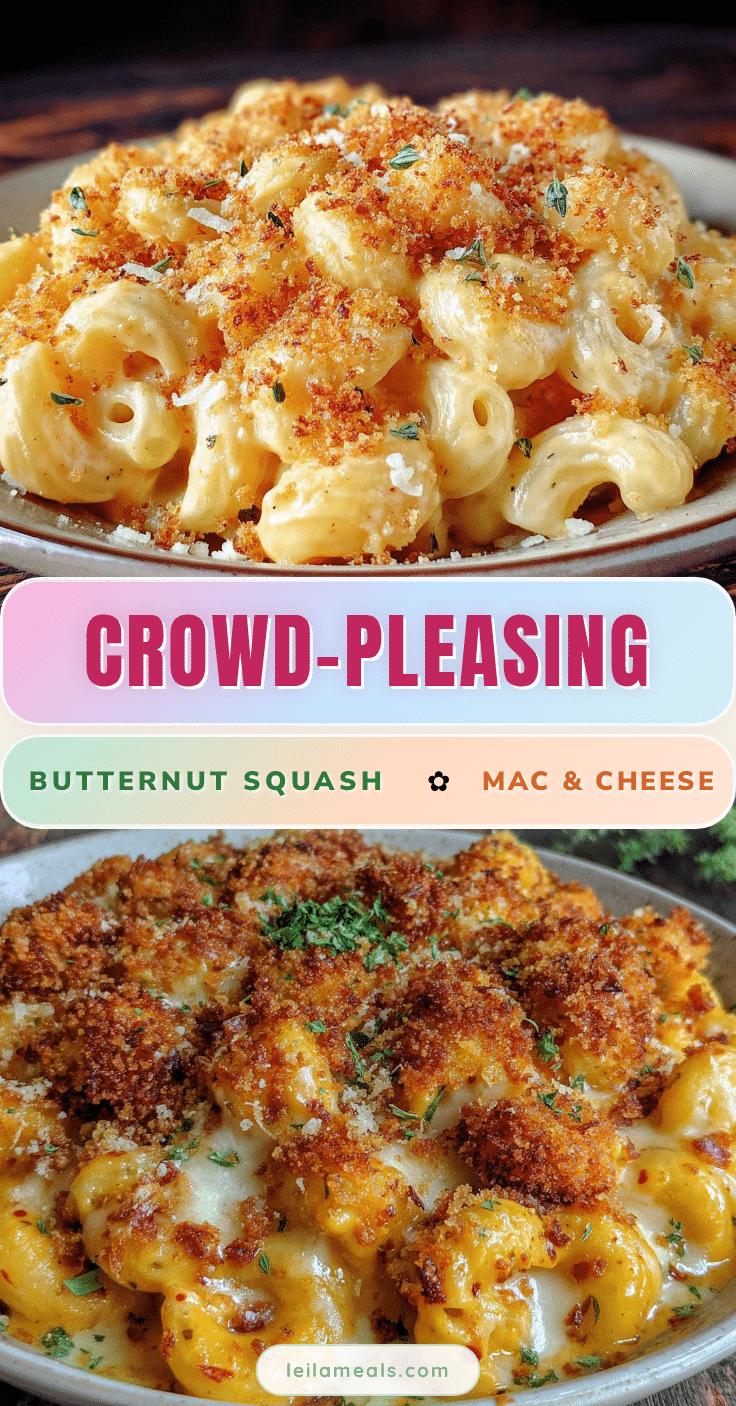
Creamy Butternut Squash Mac and Cheese: Easy Crowd-Pleaser

A velvety, crowd-pleasing mac and cheese with roasted butternut squash blended into a rich cheese sauce. Perfect for potlucks, holidays, or weeknight dinners, this dish comes together in about 45 minutes and is always the first to disappear.
- Prep Time: 15 minutes
- Cook Time: 30 minutes
- Total Time: 45 minutes
- Yield: 8 servings 1x
- Category: Main Course
- Cuisine: American
Ingredients
- 1 medium butternut squash (about 2 pounds or 900g), peeled, seeded, and cubed into 1-inch pieces
- 2 tablespoons olive oil
- 1/2 teaspoon salt
- 1/4 teaspoon black pepper
- 1 pound (450g) elbow macaroni or short pasta (e.g., cavatappi, shells, fusilli)
- 4 tablespoons (56g) unsalted butter
- 1/4 cup (30g) all-purpose flour
- 3 cups (720ml) whole milk, warmed
- 1 cup (240ml) heavy cream
- 2 cups (225g) sharp cheddar cheese, freshly grated
- 1 cup (115g) Gruyère cheese, freshly grated
- 1/2 cup (50g) Parmesan cheese, freshly grated
- 1 teaspoon Dijon mustard
- 1/2 teaspoon garlic powder
- 1/4 teaspoon nutmeg
- Salt and pepper to taste
- 1 cup (100g) panko breadcrumbs
- 2 tablespoons (28g) unsalted butter, melted
- 2 tablespoons Parmesan cheese, grated (for topping)
- Fresh thyme or parsley for garnish (optional)
Instructions
- Preheat your oven to 400°F (200°C). Line a large baking sheet with parchment paper or foil.
- Prepare the squash: Peel and cube the butternut squash into 1-inch pieces. Toss with olive oil, salt, and pepper. Spread in a single layer on the baking sheet. Roast for 25-30 minutes, flipping halfway, until tender and caramelized. Let cool slightly.
- Boil the pasta: Cook pasta in salted water according to package directions until al dente (about 1 minute less than recommended). Reserve 1 cup of pasta water, then drain. Do not rinse.
- Puree the squash: Transfer roasted squash to a blender or food processor. Add 1/2 cup reserved pasta water (or regular water). Blend until smooth. Set aside (about 1.5 cups puree).
- Make the roux: In a medium saucepan over medium heat, melt 4 tablespoons butter. Whisk in flour and cook for 1-2 minutes until light golden and nutty.
- Build the sauce: Slowly whisk in warm milk, then heavy cream. Continue whisking until thickened, about 3-5 minutes. Reduce heat to low.
- Add cheese and squash: Gradually add cheddar, Gruyère, and Parmesan, stirring until melted. Stir in Dijon mustard, garlic powder, nutmeg, and squash puree. Season with salt and pepper. Sauce should be slightly thicker than desired.
- Combine: Add drained pasta to sauce and stir until coated. If too thick, add a splash of reserved pasta water. Pour into a greased 9×13-inch baking dish.
- Make the topping: Mix panko breadcrumbs with melted butter and 2 tablespoons Parmesan. Sprinkle evenly over the mac and cheese.
- Bake: Bake for 20-25 minutes until bubbly and golden. For extra color, broil for the last 2 minutes (watch carefully).
- Rest and serve: Let rest for 5-10 minutes before serving. Garnish with fresh thyme or parsley if desired.
Notes
Roasting the squash is essential for flavor—don’t skip it. Grate your own cheese for a smooth sauce. Warm the milk and cream before adding to the roux to prevent lumps. Cook pasta al dente to avoid mushiness. Let the dish rest before serving to allow the sauce to set.
Nutrition
- Serving Size: 1 serving (about 1/8
- Calories: 550
- Sugar: 8
- Sodium: 680
- Fat: 28
- Saturated Fat: 16
- Carbohydrates: 52
- Fiber: 4
- Protein: 22
Keywords: butternut squash mac and cheese, creamy mac and cheese, easy mac and cheese, crowd-pleaser, potluck recipe, fall recipe, comfort food